The humans really need to get out of Palla’s forest.
They smell, for one thing. They cook meat and vegetables over fires made of dead wood, and the forest reeks of smoke and blood wherever they pass by.
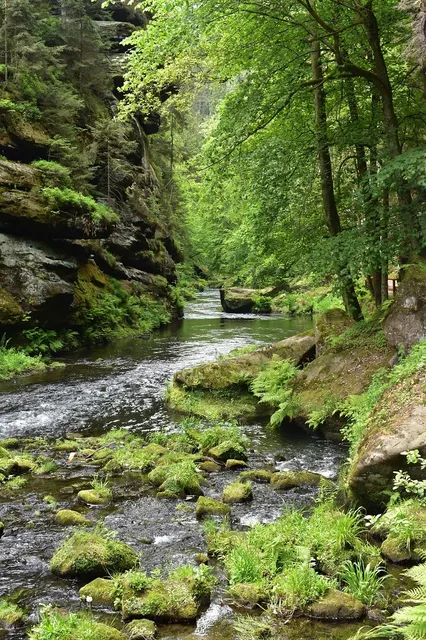
They try to wash themselves, dirtying her streams with their ragged clothes and angular, bony bodies. Pallas comes by after they leave, dipping her shining horn into the waters to purify them, and the little brown naiads come up out of the stream to thank her.
It’s a good thing that the humans never stop anywhere for long. They camp for a night, leaving stink and scorched earth behind, but at least they stand a fair chance of leaving the forest soon. Pallas follows behind, repairing what she can, and making sure they keep moving.
“They’re terrified,” a young aspen dryad tells her, shivering her silvered leaves. “can’t you tell?”
“They hurt you,” Pallas growls in reply, touching her horn to the gaping void in the aspen’s side, where the humans had torn off a green limb. It began to heal, leaving a rippling scar in the limb’s place. The dryad touched the wound thoughtfully, saddened by the loss.
“They’re hurt, themselves.” The aspen said softly. “I remember what it’s like. We were all human, once.”
“I wasn’t,” Palla said.
She had been a cart horse. The scars from her past life were nothing but memories now, her shining dapple-grey coat and agile cloven hooves all signs of a new life, a new job as the guardian and protector of the forest and its creatures. But she still had the memories, and they were not good ones.
—
The human children are not being watched properly. The adults are busied some way away, setting up their awful fires and flopped on the ground, staring up into the branches.
The children are doing . . . something else. Palla wished she knew what, so that she could properly disapprove of it. It seems to involve a lot of excitable whisper-shouting and waving sticks at one another. They are, at least, dead sticks, found on the forest floor, instead of green branches torn from living trunks, but still. Palla scowls at the humans from her hiding place behind an obliging oak.
She startles, a little, when one of the children begins sprinting straight for her, but she keeps her place. The child stumbles, falls, and tumbles end-over-end. Pallas is mildly concerned for the tiny creature’s safety, in spite of herself, but the girl jumps up again, grinning widely with gapped teeth and laughing.
Humans, Pallas thinks, dismissing the children and beginning to back away.
She sees something moving, then, in the underbrush. A snake, startled by all the movement and noise, baring its fangs and shaking its head in warning, telling the girl to back off.
The child has her back to it, and is babbling something incomprehensible to the others. Her short legs are walking slowly backwards, and the snake, frightened by the advancing threat, reels back to strike.
Palla, seasoned by years of protecting foolish young creatures in her forest, is faster. She leaps forward, planting her front hooves between the snake and the child. The snake strikes, burying its teeth in the bony knob of her knee. It’s only a young thing, and in its panic, it releases every drop of its precious venom before it realizes what it’s doing and drops away. It sees her, and immediately slithers away, looking incredibly sheepish. She snorts at it.
The poison ripples into Palla’s grey-white fur. The toxin is neutralized almost immediately, the proteins turned into pigment, her coat growing slightly darker. A dark coat is a sign of honor for a unicorn, a sign of a life well lived.
The child shrieks, startled by Palla’s sudden appearance. She looks down to find the girl fallen on the forest floor, staring up at her with wide, frightened eyes. Palla looks back at the girl, stunned. No creature of the forest looks on their guardian with fear. It should strike her as nothing more than proof—proof that the humans are no responsibility of hers—but instead it simply twists Palla’s heart oddly as she slips back into the forest. She does not like being feared. Not even by humans.
—
The snake is a young thing. She finds it again, hiding under a bush, and it rattles warningly at her as she comes close.
“Stop that,” she tells it, and it pokes its head out cautiously.
“Ssssorry,” it says. It’s jumpy, nervous, but she didn’t seek it out for an apology.
“Why are you in the forest, little one? She asks, gentle, and the little snake creeps further out from under his bush.
“The plains are all dead,” he says. “The grass is gone. All the tassty little mice—gone.”
She cocks her head at the little snake. That sounds . . . wrong, somehow. The plains can’t all be gone.
“I’m very sorry you lost your home,” she says. “the forest will keep you safe.”
Still, the little snake’s story sticks in her mind.
The plains are dead. Isn’t that where the humans were going?
Did they know?
—
“It was a deeer!”
“No! It was a horse!”
The children are arguing, quite loudly and enthusiastically, about what exactly it was they’d seen in the woods, and it was giving Nala a headache. She can’t see a way to mediate, so she is instead focusing on the little girl in her arms.
Mellicent lost her family when the Empire’s war-dragons had flown through, leaving ash and destruction in their wake. This was the first time Nala has seen the girl cry, and she has the suspicion that the child’s full-body sobs have more to do with grief than with a brief glimpse of a scary woodland creature.
The girl is whispering something to her, so Nala bends down, lending her ear to listen.
“What was that, love?” She asks, voice gentle.
“It wasn’t a deer,” the girl whispers, still sniffling, and Nala frowns.
“Was it a horse, then?” She asks. That would be odd, but not impossible. A riderless war-horse, lost in a battle somewhere, or a farmer’s colt escaped in the chaos.
“No,” the child insists. “No, it wasn’t either of them! It had a horn, and a beard!”
“Like a goat?”
The question simply seems to upset the girl further.
“No!”
Probably a deer, Nala thinks to herself. There are strange deer in the forest. All of the forest is strange, and not only in the simple fact that it seems to have survived the dragon attacks and the newly darkened sky without a scratch.
“It’s alright,” she whispers, rubbing the girl’s back. “Nothing can get you here. We’ll keep you safe, okay?”
Still, she looks up, into the gaps between the trees where the shadows painted the woods almost indigo. She hates this place. She hates the way the trees seem to absorb every sound, and the way things seem to always be moving in the shadows.
“We’ll be out of this place tomorrow,” she tells the sobbing girl in her arms, tearing her gaze away from the silent trees. “I promise.”
She can only hope that the other side of the forest is something worth running to.
—
The plains really are gone.
Even the sky is not the right color, a blazing orange light that looks nothing like the sun shining through a choking mass of brown haze. It smells of death, of burnt meat and of poison, of the rotting bodies of animals and of people. Palla flares her nostrils, trying to catch some scent of water or plant growth, but there is none.
She looks down at what once was a field of wildflowers. It is dark and wet now, oozing with noxious waters, covered in plants that are already blackened by decay. It squelches underfoot, and she can feel the poison in it. There is no life left in the soil, and left to itself, it will not grow anything but flies for years, perhaps decades.
Something inside Palla is blazing, a fury that is not new, though the strength of it surprises her. It had died down to embers, perhaps, moored over by her new life as the guardian of the forest, but it has been flickering steadily to life, growing in strength with every crackling campfire, every snapped branch and trodden-on flower. She can’t help her anger, and cannot contain it, but there is nowhere for it to go.
In her life as a cart-horse, she would have kicked something. Fought the bit, tangled the traces. But now?
She is the Guardian of the Forest now. Her anger means something.
Feeling the fury building inside her, she stamps a hoof into the squelching earth. The noxious mud oozes between her cloven toes, and she reaches, feeling the death that has settled into the land.
And she pulls.
Black lines stream up her legs, and the land around her feet begins to lose its acrid stench. Moss and mushrooms begin to spread, and as the brown-capped colonies of fungi eat away at the decaying remains of the plains, the soil grows dark and rich. Waterbears and worms teem into it, their sheer numbers making the ground shake. The pools of rust-red water begin to tremble, shaking free of their stagnant slumber and running in rivulets through the earth. The rivulets join together, gaining strength as they run down the gentle hill into the desecrated valley below, and where the water passes, fiddleheads shoot up out of the ground, unfurling into bright clusters of sweet-smelling ferns.
Palla shuts her eyes and bends her head, feeling the effort beginning to drain her. The forest had never had this much death in it. It had never needed her help this badly. Even her fury is waning, and in its place is a determination to see this through, to heal the ragged wound on the land with every ounce of strength in her possession. There is so much poison. So much death.
She pulls with all her might. Death becomes decay, decay becomes good soil, and the rich earth is soon riddled with the roots of swift-growing plants. Even the air clears of its reddish haze, letting the sunlight paint the ferns a shade of green more brilliant than any jewel, a and the bitter waters that had been muddying the earth stream down into the valley to form a lake, sparkling in the sunlight, and smelling as sweet and clean as the streams in Palla’s forest. Delicate red columbine waves in a cool breeze, and white trilliums dot the hillside as it descends towards the lake. Forest flowers, blinking dazedly in the sun, seeming faintly surprised by their own presence there. No more death. No more rot. No more poison.
She stops pulling, gazing out at the sight. It’s beautiful.
As soon as she stops, she feels something. An ember of latent fury, mostly smoldered, but still burning in her belly, waiting to come to life again.
She doesn’t want it anymore. Doesn’t need it, in the way she once had. She pulls in a deep breath, and as she lets it go, she lets the anger go, too. It is a strange relief; like taking off a bandage to find the wound underneath is now nothing but a pale scar.
She can hear the voices of humans approaching. They sound tired, and hopeful. They sound like they need the rest that this place can provide them.
Palla slips back into the forest shadows before anyone can see her. Her coat blends in with them now—what had been a light dappled grey this morning is now a deep and inky black. A mark of honor, among unicorns. A sign of a life well lived.
And best of all, she thinks wryly, leaving the sounds of voices behind: those humans are finally out of her forest.
style=”display:none;”>